Over two and a half years later here is the follow-up to my blog: “I Love Japanese Buddhist Temples Pt. 1.”
A lot of thoughts have been swirling in my mind lately. A big part of that is being triggered by the conversation surrounding women’s rights and terminating pregnancy. How uncanny is it that the Buddhist Temple I visited on my trip to Fukuoka would be dedicated to this very subject? It would appear that fate has a way of creeping up on us when we least expect it.
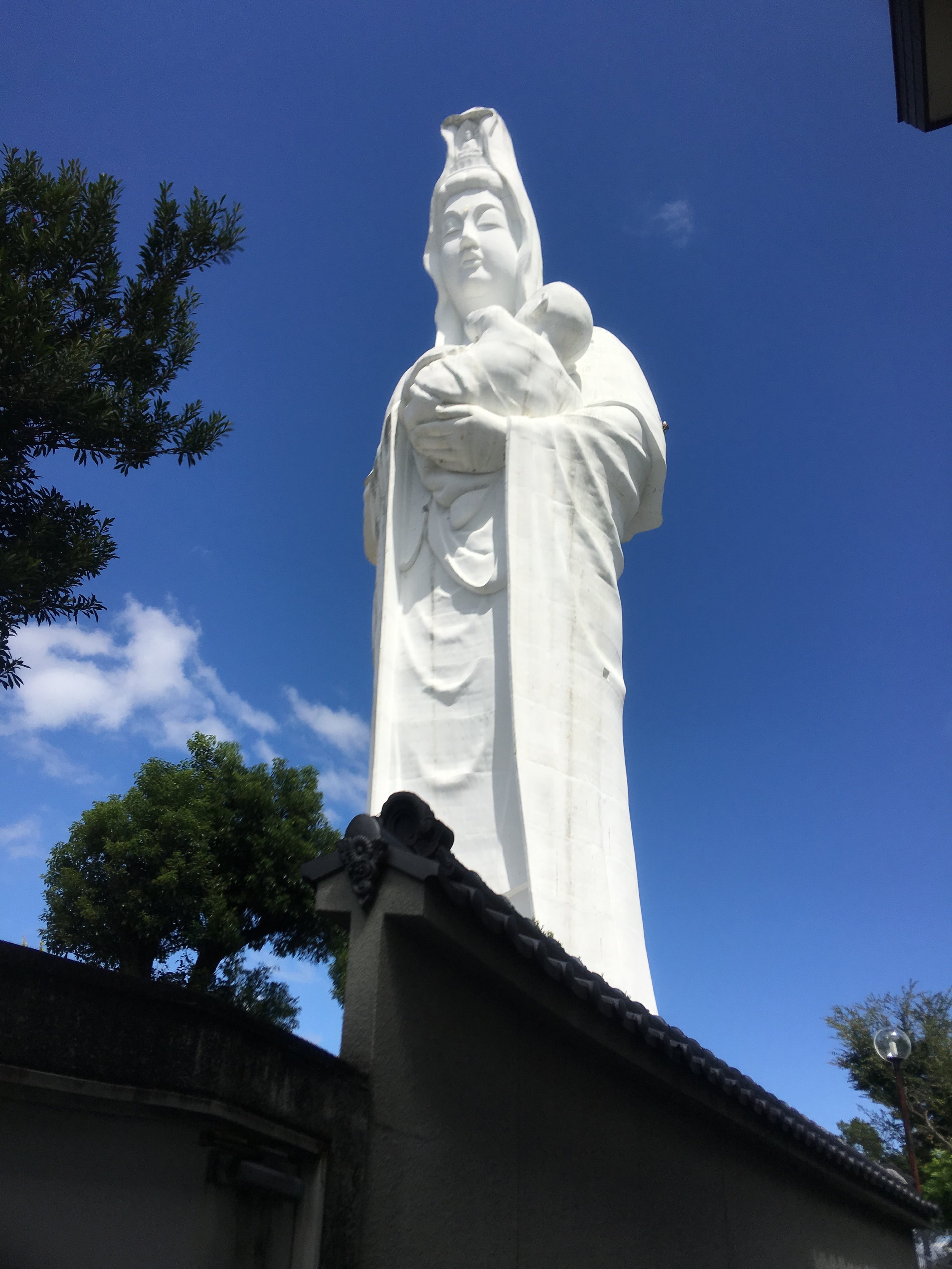
The Buddhist Temple we climbed up was The Daihonzan Naritasan Kurume Temple. The enshrined deity is that of Fudō Myo-o, a powerful Buddhist God who converts anger into salvation. This Buddhist God has a furious and death glaring face, which Fudō uses to frighten people into accepting the teachings of Buddhist Law.
Fudō Myo-o is depicted as carrying a devil-subduing sword in their right hand, which represents wisdom cutting through ignorance, while the left hand is used to catch and bind up demons. Often the third eye is exposed in the forehead (Pineal gland) And Fudō Myo-o is often seated or standing on a rock because Fudō is “immovable” in their faith. Fudō is also worshiped as a deity who can bring about monetary fortune.
When you go inside Fudō, you climb up what feels like a thousand steps! It is 203 feet / 68 meters tall, so you really have to prepare yourself for the hike. There are several different levels inside the structure, with Buddha statues, paintings, and art work as you walk your way up.
There is one level that I remember so vividly. It’s called “The Room with a Thousand Buddhas,” and it is quite literally a level where there are a thousand Buddhas. It is about three-quarters of the journey up Fudo. I remember stopping at this level and feeling overwhelmed with all the golden Buddha statues staring at me. I wanted to take a photo but refrained from doing so. It seemed too special of a place to cheapen with a tourist’s photo. Have you ever seen a room full of a thousand golden Buddha statues? It is quite overwhelming and something struck deep in my belly and sent shivers up my spine.
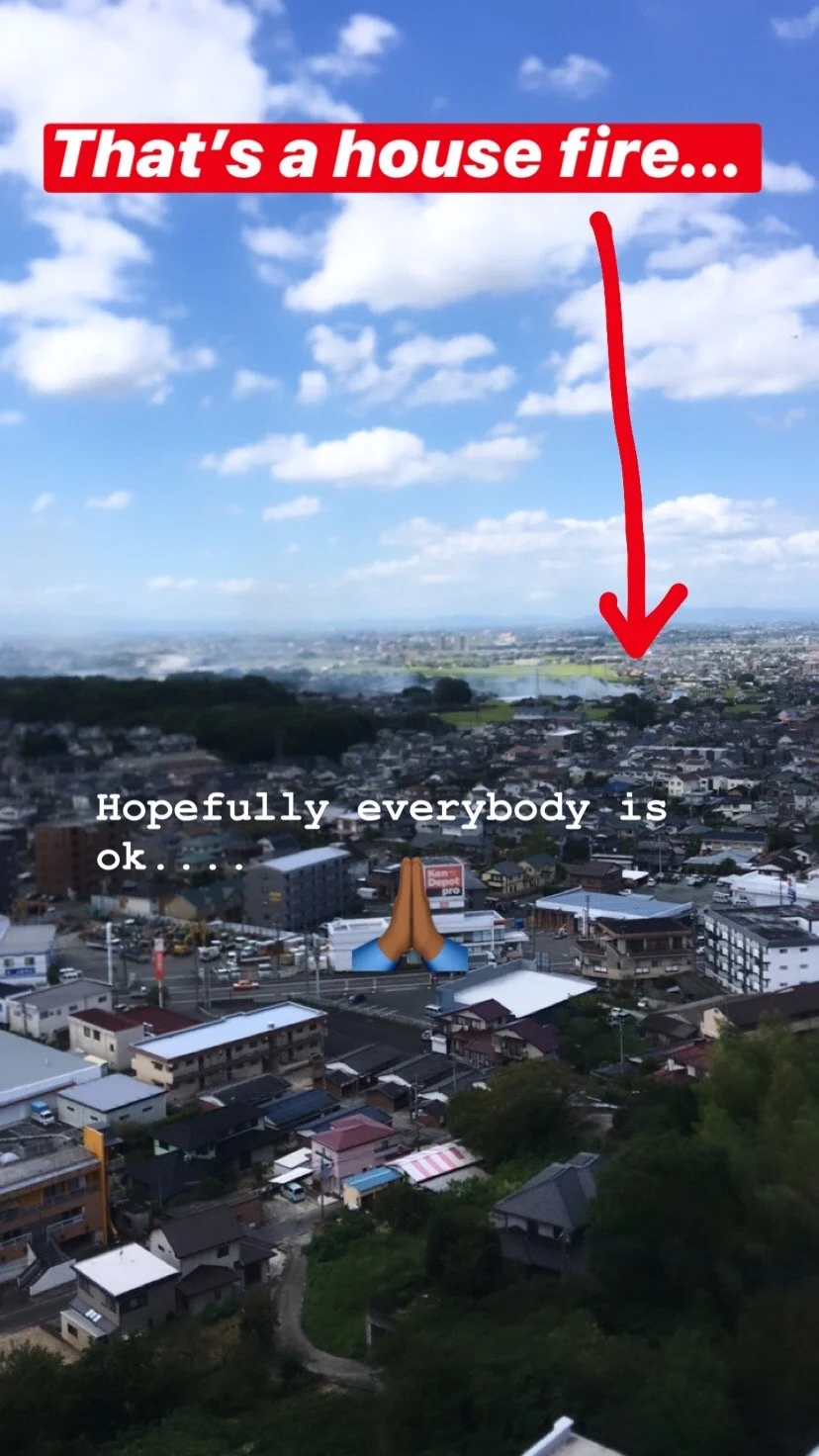
As we got to the top there was a spot where we could look over the city. It was here that I saw a fire happening at a house below. I posted it on my IG stories hoping that everyone was okay. I still hope that everybody is okay.
The journey up Fudo is going to mean something different for everyone. Walking up this temple can be viewed as a form of physical catharsis. You know how sometimes people workout really hardcore, just to feel the burn? As if the workout itself is a self-cremation of sorts. Like, a self-cremation of emotions deep inside the body? That is the feeling that climbing up the top of Fudo recreates.
This physical journey up Fudō is supposed to make you feel physical catharsis. After that kind of workout you’ve pumped so much blood up into the Pineal gland that once you’re done, your brain has no choice but to emit alpha brainwaves. This is why shavasana is so important in yoga practice because that stillness really allows you to feel the joy of emitting alpha brainwaves. That feeling is powerful. It is an easy replacement for any harmful vice we feed the body.
I think about how standing inside the top of that Temple inside Fudō would mean something different to everybody. I think about a Mother who has just miscarried and how the hike up this Temple would be a physical manifestation of letting go of that child. I’ve never had a girl pregnant. I’ve never suffered a miscarriage. So to me, none of this is relevant but I still hold compassion in my heart for anybody that has suffered a loss of life whether by choice or by bad luck. Perhaps it wasn’t for me to seek benefit from an experience like this directly, but to learn about how to hold love and compassion in my heart for others.
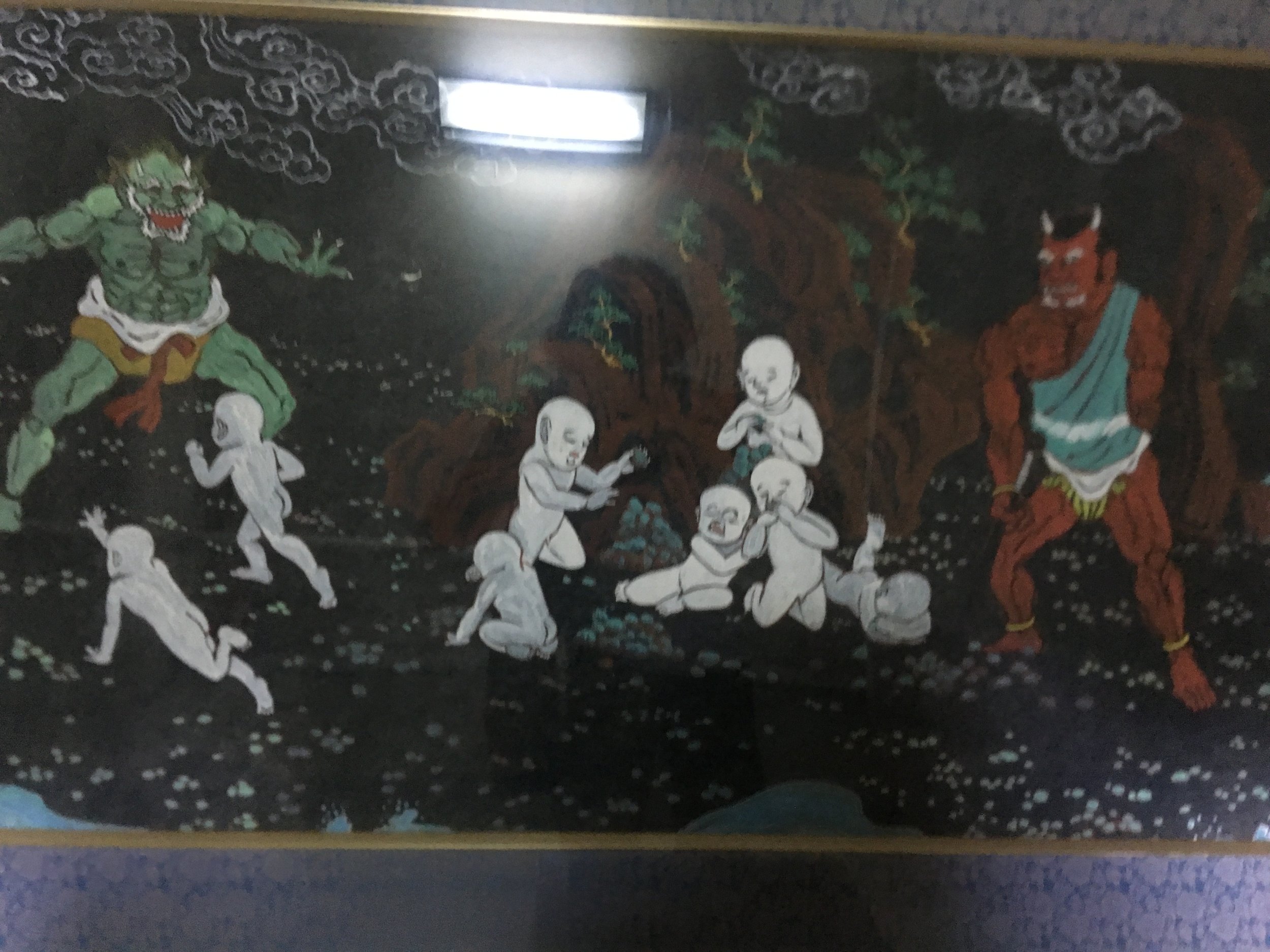
Purgatory Baby Artwork
On the walls on the way down there are some paintings. I am not an art historian but I can see those over-sized babies running around while surrounded by some type of dragon/demon. These paintings are but a small recipe of what is next on this Buddhist Temple journey.
The structure was built in 1953, 5 years after Japan legalized abortion. You can view this Temple as a Buddhist response to the topic of terminated pregnancies. This is where many couples would visit after suffering a miscarriage or a terminated pregnancy as means of catharsis and reflection. I mentioned in my last blog post also about how peaceful the garden area was. I now understand that this garden is a place that allows us to sit and reflect and be still with our thoughts after we have climbed Fudō Myo-o.
I’m getting lazy now so I’m just going to write directly from a tour guide pamphlet we were given on this journey. It does a much better job of explaining than I do:
“The Kurume Naritsaan Temple was opened in December, 1958 as a division of the main temple Naritsaan-Shinshoji in Chiba Prefecture. It is noted nationally as a major “migawari fudouson” (a place where the victim of some illness or misfortune may remove his discomfort by the help of Fudo). The Kurume Naritasan Temple is supposed to provide blessings for traffic safety, fortune increase, business success, family well-being, the salvation of aborted babies, the gratification of all wishes, protection from evil.
“Jibo Kannonzou” (the large, motherly statue) was built in January, 1983. It is 62 meters high, the largest “Kannonzou” (goddess of mercy statue) in Kyushu. On the forehead of the statue are jewels set in the “byakugo,” which was originally a white hair between the brows of Buddha. The jewel found in the center of the breast, the “Yoraku” is said to provide everyone with protection from evil, Inside the body of the statue, images of 3 other Buddhist Fods can be found:
1) Dainchi Nyorai - principle image of Buddha in the Shingon Esoteric Buddhism
2) Shaka Nyorai - Shakamuni Goutama, the founder of all Buddhism
3) Yakushi Nyorai - Buddha of medicine, who releases people from pain and cures their illnesses.
Through these Buddha, people pray for the prosperity of their family and relatives, for the longevity of their descendants, and for general health. Halfway up the inside staircase, one can find “Sentaibutsu,” a thousand images of Buddha, popularly believed to be potent because of the large number of figures. These images stand in memory of ancestors and aborted babies.”
*
Downstairs inside the feet of the temple has a set of different rooms. Inside these rooms are various depictions of heaven and hell in the Buddhist religion. You aren’t allowed to take photos inside these rooms. Obviously you can because the Japanese are very non-confrontational and if you did it they’d just pretend they didn’t see. But for me, I am superstitious and I refrained from taking photos.
I did snap one photo of the entrance leading into “Hell,” which I have here:
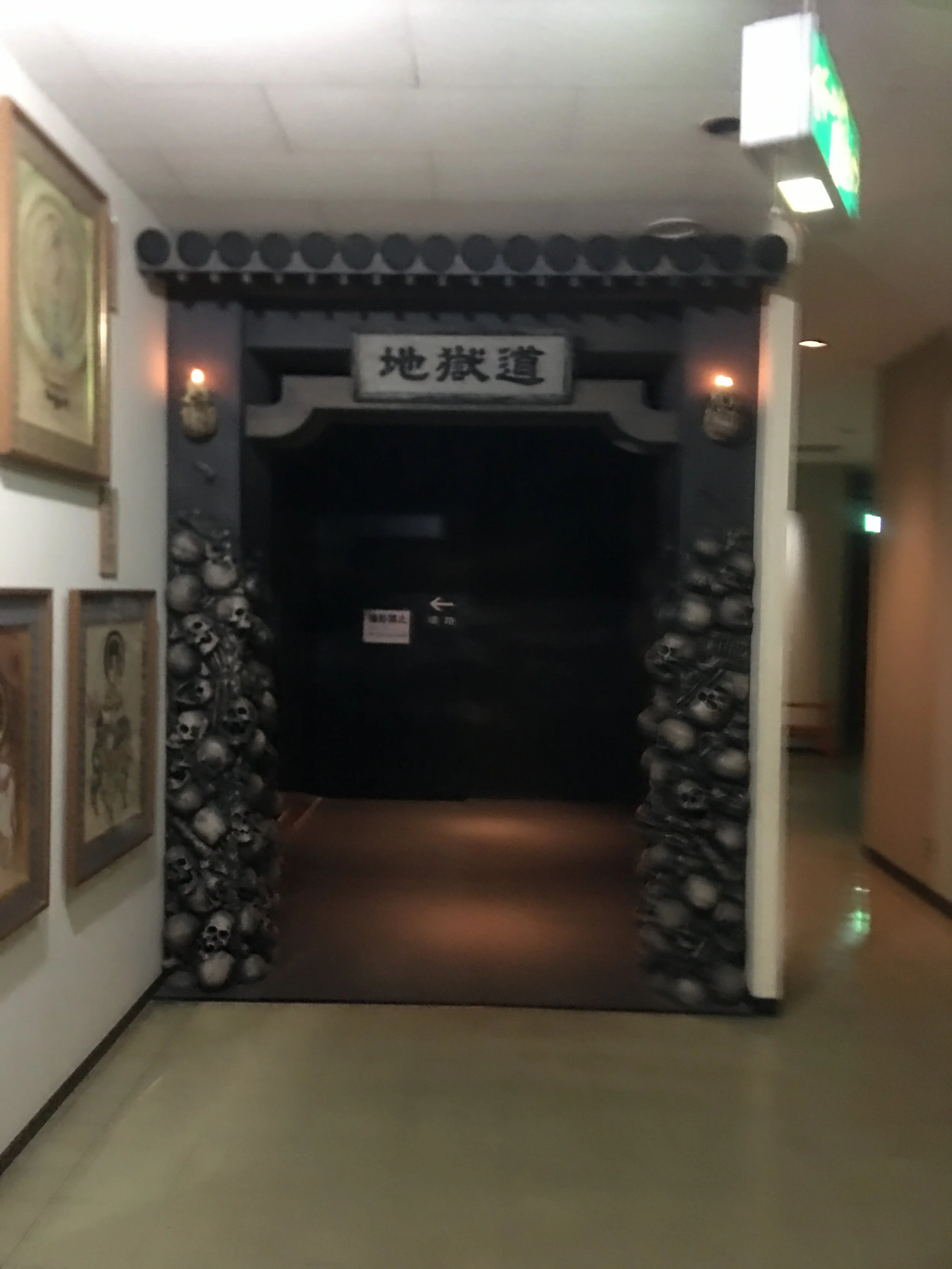
As you can see there are a ton of baby skulls building the gateway into hell. This is only the beginning, inside it gets far darker and much more gruesome. The depictions of hell are so memorable to me.
The depictions of heaven were incredibly tranquil and beautiful, so there definitely is a balance. You walk through hell first, and then you go through heaven later, which to me beautifully symbolizes one’s journey through life and into enlightenment. Sometimes you’ve got to go through hell before you can really get to, and appreciate, Heaven.
This Temple is such a beautiful way for a country to deal with a delicate topic such as abortion. With everything that has been happening in the news lately, it is important to support women’s rights. More importantly than supporting women’s rights, we have to recognize what loving and protecting women looks like.
If we love women, and we really seek to protect them, we should live our lives in a way that is centered around that notion. That is what is so beautiful to me about this Temple is that it is a place to seek peace, forgiveness, and atonement for all the various complications surrounding the delicate nature of life.
It is believed in the Buddhist culture that if a woman has chosen to have an abortion, she must raise at least one child in order to offset the karmic balance of this act. I remember hearing somewhere that this is the reason why Angelina Jolie has so many kids. I’m not going to say or speculate on how many terminated pregnancies anybody has had because it is none of my business, nor am I ever in any position to judge. What I am in a position to do is hold compassion and empathy in my heart to people who have suffered the loss of life for any reason: whether deliberate or by twisted karmic fate, I hold place in my heart for anybody who has had to suffer.
I encourage all people who have lived through this journey and have yet to find resolve, or have yet to reach a place of self-forgiveness, I highly encourage them to visit this Temple as a means of honoring that memory. Whether they go with the person they did this with, or whether they go alone it does not matter. What matters is honoring life and accepting how important the sanctity of life truly is. This is a place to go and seek refuge and gain peace within one’s soul. I’ve said it once and I’ll say it again: what a beautiful way to deal with such a sensitive topic.
I think about Polynesia and my own cultural heritage and how we deal with the unborn and I think of my childhood best friend Malcolm, who is half Cook Islander. I remember going to their house and seeing a series of photographs of flowers, each one pink, and each one inside their own individual frames. There were maybe 7 of them. Next to these photos of flowers were a series of portraits of both Malcolm and his little sister Leilani-Grace. A portrait for each and every single year of life, which was really entertaining seeing what the kids looked like at every year of life. Super cute!
I’d never really given much thought about the photos of the flowers but now I understand the significance of them. Each flower, within each individual frame, next to photos of the 2 children were representations of miscarriages. When I was younger I thought these were morbid but now as a fully grown adult that has visited Japanese Buddhist Temples I realize that this is actually beautiful. This is the only Pacific Island way of dealing with this topic that I’m familiar with. I don’t know how Tongans deal with the topic of abortion, all I know is that you can’t get access to one in Tonga because it is still illegal.
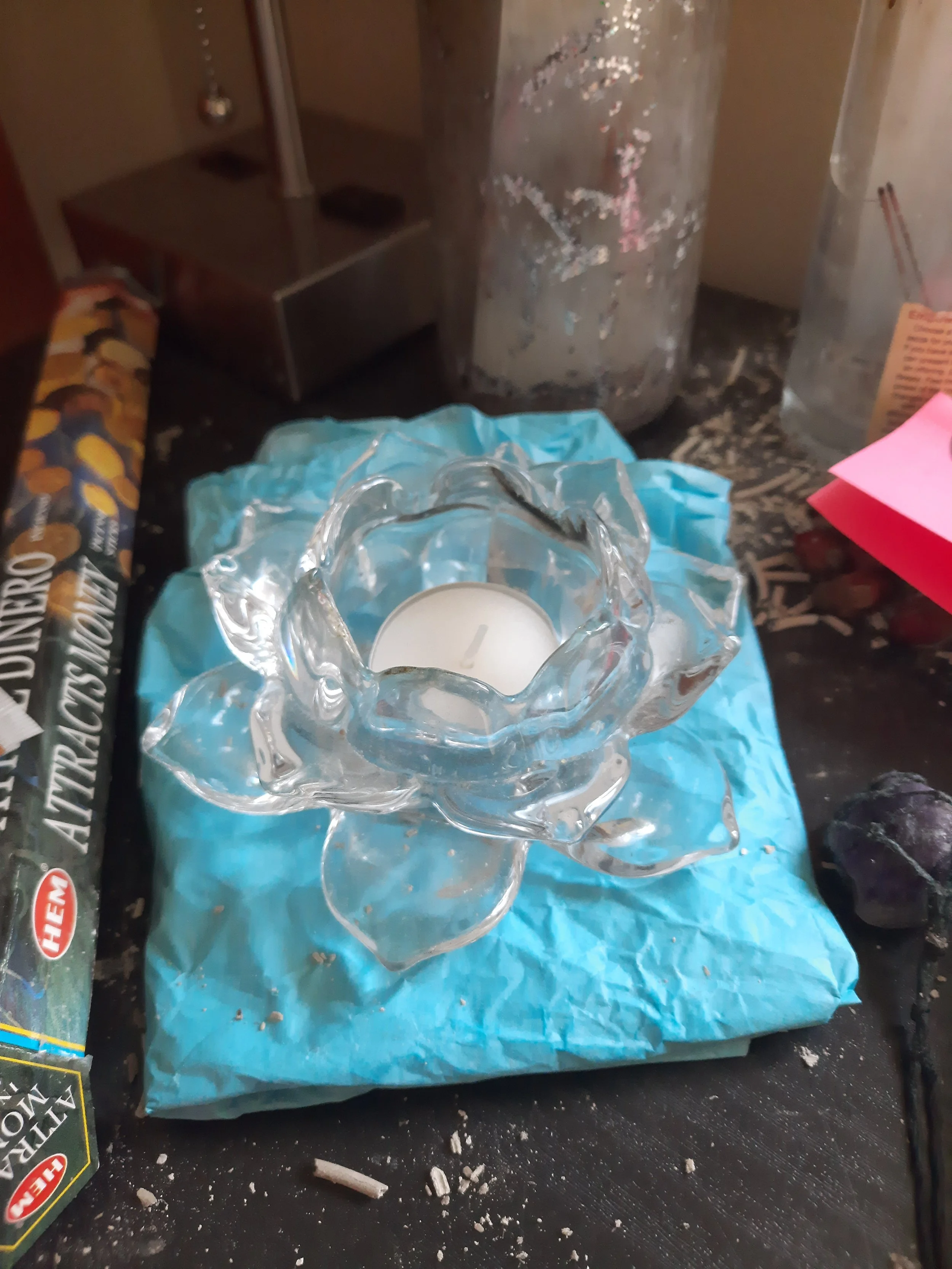
I don’t know what the standard practice of gifting is as far as unborn children are concerned, but I think getting somebody who has gone through that traumatic experience a plant is a beautiful way of recognizing it. Lately I’ve been lighting a candle every night alongside my Anahata chakra (heart center) candle. The reason why I am doing this is simple: I want to honor life.
And when I stare at my little candle burning inside the lotus flower - the one I use to honor life - I think of all the ways I can hold space and compassion inside of my heart for others.