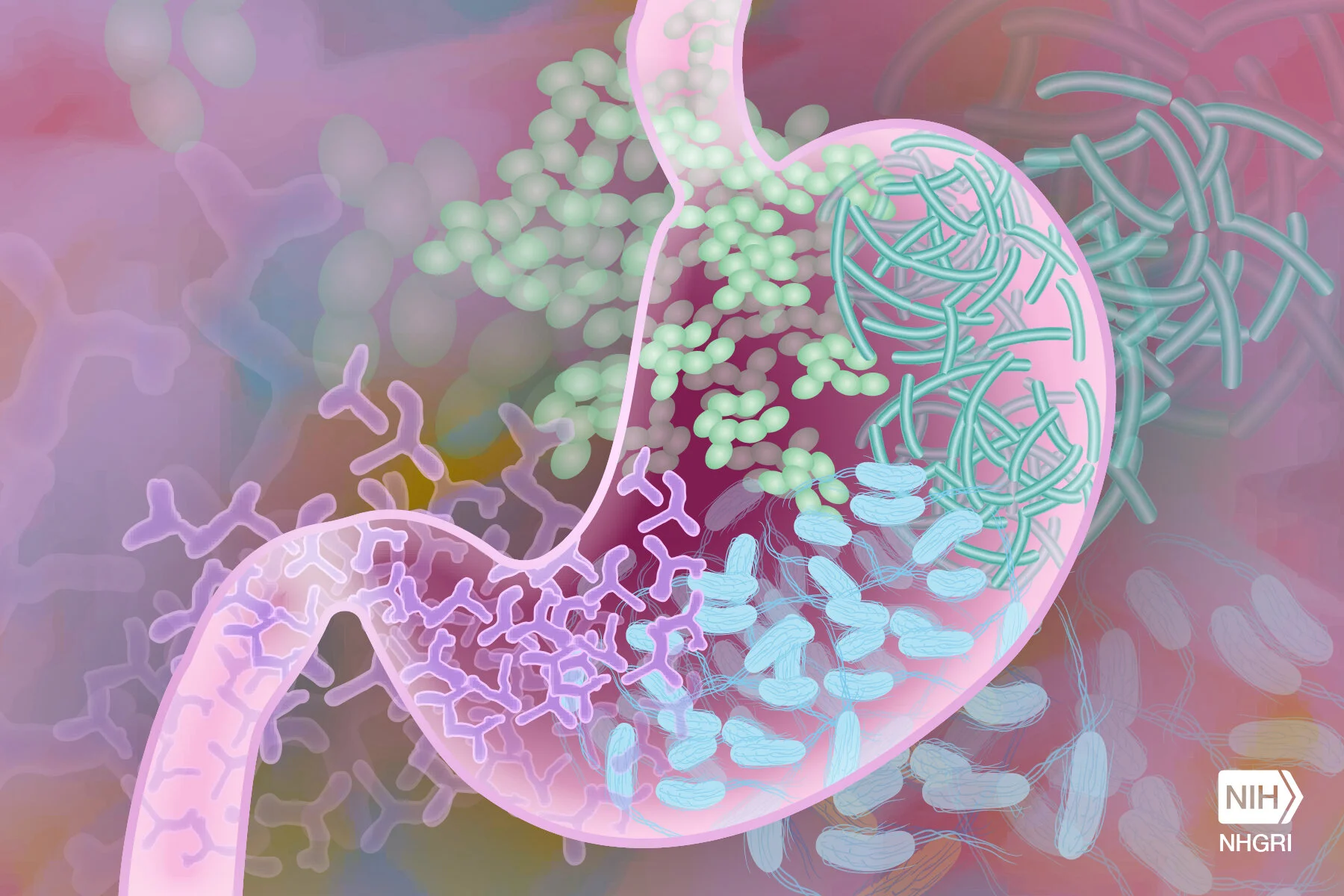
Research on the human microbiome has only been developing within the past 15 years, which shows that western medicine is still going to great lengths to understand how much of a connection there is between overall health and the microbes in our stomach. My goal is to teach people how to balance the chemicals in your stomach/gut/microbiome so you can feel better, live stronger, and be happier. The first part is understanding that our stomach is an incredibly important and very complicated organ in the first place.
Have you heard of the gut-brain axis? New scientific evidence is suggesting that there’s a definite link between the human microbiome (gut health) and mood disorders.
Imbalances in gut microbiota are found to be associated with more bodily disorders including: inflammatory diseases (Clemente et al., 2018), metabolic diseases (Bouter et al., 2017), irritable bowel syndrome (Mayer et al., 2014), and most importantly of all neuropsychiatric disorders (Sharon et al., 2016).
Have you ever noticed how people with a stomach ache are always irritable? Nobody with an upset stomach is ever in a good mood. When our stomachs hurt, everything hurts, and everything feels wrong and nothing feels right. Think back to a time in your life when you got a stomach flu, or food poisoning, it can sometimes feel like you’re dying.
This is how I felt when I was training for Rio 2016, I had stomach pains around the clock and my mood suffered immensely. And when I did more research into how many micro-organisms live inside our gut, it all started to make more sense, and I recognized that there’s a serious relationship between the gut and brain, called The Gut-Brain Axis.
Research has shown that the human intestinal tract contains between 10 to 100 trillion microbes. That’s roughly 10 times greater than the amount of human cells (Bäckhed et al., 2005), which means there’s a lot going on in our stomachs at the biochemical level than we ever realized before. We’re all just walking chemical equations, and inside our stomach houses more microbes than what make up our entire body, by roughly 10 times in fact.
The human microbiota - which means all the micro-organisms living inside your stomach - contain 100 times the number of genes than that of the human genome (Bäckhed et al., 2005; Grice and Segre, 2012). So, my dear, there’s are a lot going on between the entrance of your mouth, all the way to your bootyhole. Or if you want to keep it classy like Miss Frazzle from The Magic School bus: your “valve”: